
PETAL Consortium: 2025 – A Year in Review
PETAL Consortium: 2025 – A Year in Review
PETAL Consortium: 2025 – A Year in Review
By Katrina Fu
By Katrina Fu
As we wrap up 2025, let’s look back at PETAL Consortium’s biggest achievements this year!
As we wrap up 2025, let’s look back at PETAL Consortium’s biggest achievements this year!
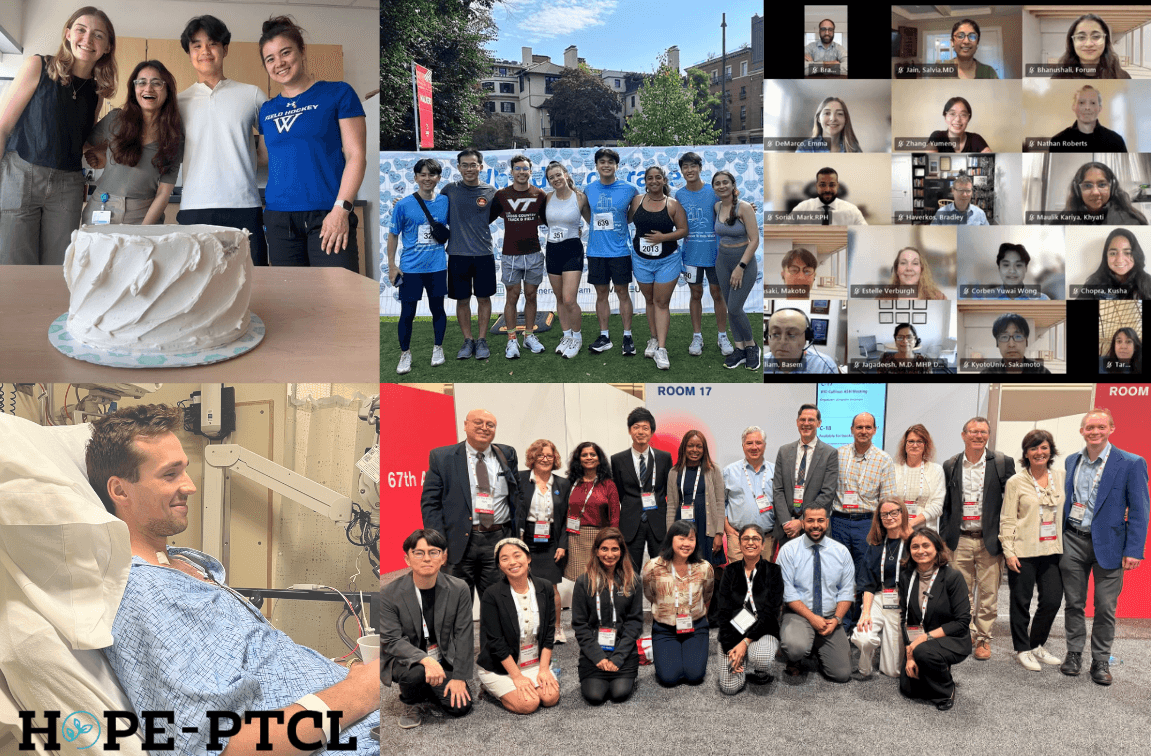
In July, PETAL celebrated enrolling our 100th patient with 🎂! UPDATE: as of this month, we now have 185 patients across 22 sites 🎉
Over the summer, the Massachusetts General Hospital team participated in a 5K run-walk to raise money for peripheral T-cell lymphoma (PTCL) research!
In October, we held our first steering committee meeting–connecting principal investigators across different time zones from Australia to Japan to North America!
In December, we launched HOPE-PTCL (Hub for Outreach and Patient Engagement in Peripheral T-cell Lymphoma), PETAL’s patient education website!
Also in December, PETAL attended the 67th American Society of Hematology (ASH)’s Annual Meeting in Orlando, where Mark Sorial, Co-investigator and Biostatistician, presented PETAL’s latest manuscript. This manuscript was also covered in MIT News!
AT ASH, other PETAL team members–Salvia Jain, Enrica Marchi, and Colin Thomas–gave oral presentations on important clinical and translational findings. Additionally, PETAL held its second steering committee meeting to discuss study progress, committee initiatives, and strategic priorities.
Throughout 2025, PETAL was featured in Mass General Brigham news one, two, three, four, five times!
Finally, this year PETAL has grown across the board–from more sites/waitlists to welcoming more members to our Center for Clinical Investigations and core teams.
🌸 To get all the latest updates, follow us on LinkedIn, Instagram, Facebook, and X!
In July, PETAL celebrated enrolling our 100th patient with 🎂! UPDATE: as of this month, we now have 185 patients across 22 sites 🎉
Over the summer, the Massachusetts General Hospital team participated in a 5K run-walk to raise money for peripheral T-cell lymphoma (PTCL) research!
In October, we held our first steering committee meeting–connecting principal investigators across different time zones from Australia to Japan to North America!
In December, we launched HOPE-PTCL (Hub for Outreach and Patient Engagement in Peripheral T-cell Lymphoma), PETAL’s patient education website!
Also in December, PETAL attended the 67th American Society of Hematology (ASH)’s Annual Meeting in Orlando, where Mark Sorial, Co-investigator and Biostatistician, presented PETAL’s latest manuscript. This manuscript was also covered in MIT News!
AT ASH, other PETAL team members–Salvia Jain, Enrica Marchi, and Colin Thomas–gave oral presentations on important clinical and translational findings. Additionally, PETAL held its second steering committee meeting to discuss study progress, committee initiatives, and strategic priorities.
Throughout 2025, PETAL was featured in Mass General Brigham news one, two, three, four, five times!
Finally, this year PETAL has grown across the board–from more sites/waitlists to welcoming more members to our Center for Clinical Investigations and core teams.
🌸 To get all the latest updates, follow us on LinkedIn, Instagram, Facebook, and X!
Publications
Publications
PETAL released 4 papers this year!
PETAL released 4 papers this year!
Published in Blood Advances, this study looked at patients worldwide with T-cell and NK-cell lymphomas which had relapsed or were refractory. Study authors analyzed data from an international global cohort of 925 patients to build a new risk scoring system that helps doctors better predict patient outcomes.
“We created a new scoring system, the prognostic index for relapsed/refractory T-cell lymphoma (PIRT) score, that classifies patients into low-, intermediate-, or high-risk groups based on different chances of survival,” said the study’s lead author Jessy Xinyi Han. “This work provides doctors with a new, easy-to-use tool to better predict patient outcomes and personalize treatment for aggressive T-cell lymphomas when the disease returns.”
Published in Blood Advances, this study looked at patients worldwide with T-cell and NK-cell lymphomas which had relapsed or were refractory. Study authors analyzed data from an international global cohort of 925 patients to build a new risk scoring system that helps doctors better predict patient outcomes.
“We created a new scoring system, the prognostic index for relapsed/refractory T-cell lymphoma (PIRT) score, that classifies patients into low-, intermediate-, or high-risk groups based on different chances of survival,” said the study’s lead author Jessy Xinyi Han. “This work provides doctors with a new, easy-to-use tool to better predict patient outcomes and personalize treatment for aggressive T-cell lymphomas when the disease returns.”
Published in the British Journal of Haematology, this study examined the overall survival of patients with mature T-cell lymphoma who received any one of the following drug classes as their second or third type of therapy: cytotoxic chemotherapy, epigenetic modifiers, or small molecule inhibitors. Investigators used machine learning models to estimate and compare survival after treatment.
“We found that using small molecule inhibitors earlier on in the treatment sequence, as early as the second treatment, improved survival compared to other second-line options; in the third treatment setting, epigenetic modifiers used after small molecule inhibitors also seemed to improve survival compared to most other strategies,” said the study’s lead author Mark Sorial. “This study provides a framework for how to personalize treatment selection for T-cell lymphoma and other diseases.”
Published in the British Journal of Haematology, this study examined the overall survival of patients with mature T-cell lymphoma who received any one of the following drug classes as their second or third type of therapy: cytotoxic chemotherapy, epigenetic modifiers, or small molecule inhibitors. Investigators used machine learning models to estimate and compare survival after treatment.
“We found that using small molecule inhibitors earlier on in the treatment sequence, as early as the second treatment, improved survival compared to other second-line options; in the third treatment setting, epigenetic modifiers used after small molecule inhibitors also seemed to improve survival compared to most other strategies,” said the study’s lead author Mark Sorial. “This study provides a framework for how to personalize treatment selection for T-cell lymphoma and other diseases.”
Published in Blood Advances, this study looked at how well a drug combination–duvelisib and romidepsin–worked in patients with peripheral and cutaneous T-cell lymphomas (PTCLs and CTCLs). Investigators tracked how patients’ lymphomas responded to this drug combination and whether patients could move onto stem cell transplant.
“The drug combination helped shrink or eliminate cancer in 61% of patients, with 47% having no detectable cancer,” said the study’s lead author Josie Ford. “Eleven patients successfully went on to stem cell transplant, which can potentially cure the disease… These results confirm the drug combination’s strong potential as a real-world treatment option for patients with relapsed/refractory PTCLs and CTCLs.”
Published in Blood Advances, this study looked at how well a drug combination–duvelisib and romidepsin–worked in patients with peripheral and cutaneous T-cell lymphomas (PTCLs and CTCLs). Investigators tracked how patients’ lymphomas responded to this drug combination and whether patients could move onto stem cell transplant.
“The drug combination helped shrink or eliminate cancer in 61% of patients, with 47% having no detectable cancer,” said the study’s lead author Josie Ford. “Eleven patients successfully went on to stem cell transplant, which can potentially cure the disease… These results confirm the drug combination’s strong potential as a real-world treatment option for patients with relapsed/refractory PTCLs and CTCLs.”
Published in Blood, this study found that among patients who achieved a complete remission after initial chemotherapy treatment, survival was worse for those whose disease relapsed within 12 months of initial treatment. The study used data from sites around the world to study patients with this rare form of cancer.
“This was a global effort involving more than 100 investigators and data from patients with nodal T-cell lymphoma across three major research groups–PETAL Consortium (global with U.S. predominance), GELL (Latin America), and LYSARC (Europe),” said the study’s lead author Mark Sorial. “Our findings shed light on the differences we see in patient outcomes and pave the way for more personalized treatment strategies.”
Published in Blood, this study found that among patients who achieved a complete remission after initial chemotherapy treatment, survival was worse for those whose disease relapsed within 12 months of initial treatment. The study used data from sites around the world to study patients with this rare form of cancer.
“This was a global effort involving more than 100 investigators and data from patients with nodal T-cell lymphoma across three major research groups–PETAL Consortium (global with U.S. predominance), GELL (Latin America), and LYSARC (Europe),” said the study’s lead author Mark Sorial. “Our findings shed light on the differences we see in patient outcomes and pave the way for more personalized treatment strategies.”
Patient Stories
Patient Stories
Expert care helps college athlete strike out rare, aggressive blood cancer twice
Expert care helps college athlete strike out rare, aggressive blood cancer twice
After college senior Henry’s PTCL returned, expert care from PETAL Consortium founder Dr. Salvia Jain helped him recover and reunite with his baseball team. Grateful for the support he received, Henry raised over $50,000 to help PETAL purchase a microbioreactor, a device used to grow lymphoma cells for research!
After college senior Henry’s PTCL returned, expert care from PETAL Consortium founder Dr. Salvia Jain helped him recover and reunite with his baseball team. Grateful for the support he received, Henry raised over $50,000 to help PETAL purchase a microbioreactor, a device used to grow lymphoma cells for research!
Fight, flight, or both? Randy’s T-cell lymphoma journey
Fight, flight, or both? Randy’s T-cell lymphoma journey
When retired banker Randy relapsed with peripheral T-cell lymphoma, swift access to expert care became critical. With the support of Dr. Jain, her team at Massachusetts General Hospital, and a friend with a private jet, Randy received life-saving treatment just in time!
When retired banker Randy relapsed with peripheral T-cell lymphoma, swift access to expert care became critical. With the support of Dr. Jain, her team at Massachusetts General Hospital, and a friend with a private jet, Randy received life-saving treatment just in time!
PETAL Favorites
PETAL Favorites
Favorite hobby: “I have my own pottery wheel and kiln, and I try to make things like bowls, plates, and vases.” – Shambhavi Singh, Affiliated Researcher in Genomics
Favorite food: “Cantonese-style lobster with ginger and scallion, steamed fish with hot oil, white rice, baby pea shoots, and a Diet Coke.” – Alexandra Lenart, Clinical Research Coordinator
Favorite TV show/movie: “The Big Bang Theory, Two Weeks’ Notice, or The Proposal.” – Salvia Jain, Founder and Principal Investigator
Favorite vacation destination: “[Thailand]–home to the best food and the friendliest people.” – Christina Poh, City of Hope Principal Investigator and Director of HOPE-PTCL
Favorite flower: “My wife's favorite flower is peonies… so I’ll say peonies too.” – Mark Sorial, Co-investigator and Biostatistician
🌸 To learn more about our team, click on the profiles on our About Us page!
Favorite hobby: “I have my own pottery wheel and kiln, and I try to make things like bowls, plates, and vases.” – Shambhavi Singh, Affiliated Researcher in Genomics
Favorite food: “Cantonese-style lobster with ginger and scallion, steamed fish with hot oil, white rice, baby pea shoots, and a Diet Coke.” – Alexandra Lenart, Clinical Research Coordinator
Favorite TV show/movie: “The Big Bang Theory, Two Weeks’ Notice, or The Proposal.” – Salvia Jain, Founder and Principal Investigator
Favorite vacation destination: “[Thailand]–home to the best food and the friendliest people.” – Christina Poh, City of Hope Principal Investigator and Director of HOPE-PTCL
Favorite flower: “My wife's favorite flower is peonies… so I’ll say peonies too.” – Mark Sorial, Co-investigator and Biostatistician
🌸 To learn more about our team, click on the profiles on our About Us page!
Before you go…
Before you go…
2025 has been an especially challenging year for those of us working in healthcare and research–particularly in the US. Despite the obstacles, we’re deeply grateful to all PETAL team members for your continued dedication to advancing science and improving patient outcomes. Together, we will continue to push through these murky times and support the breakthroughs that help PETAL bloom 🪷
2025 has been an especially challenging year for those of us working in healthcare and research–particularly in the US. Despite the obstacles, we’re deeply grateful to all PETAL team members for your continued dedication to advancing science and improving patient outcomes. Together, we will continue to push through these murky times and support the breakthroughs that help PETAL bloom 🪷
PETAL Leadership
PETAL Leadership
Steering Committee
Steering Committee
Salvia Jain, Chair
Stefan Barta, Co-chair
Salvia Jain, Chair
Stefan Barta, Co-chair
Executive Committee
Executive Committee
Salvia Jain, Study Chair
Bonnie Piantadosi, Coordinating Center Co-lead
Forum Bhanushali, Coordinating Center Co-lead
Nirajan Puri, Committee Member
Mark Sorial, Committee Member
Publications Committee
Publications Committee
Nora Bennani, Chair
Christina Poh, Co-chair
Mark Sorial, Co-chair
Bonnie Piantadosi, Executive Committee Lead
Pathology and Genomics Committee
Pathology and Genomics Committee
Govind Bhagat, Chair
Valentina Nardi, Co-chair
Robert Willim, Committee Member
Nichols Meredith, Committee Member
Salvia Jain, Committee Member
Outreach and Engagement Committee
Outreach and Engagement Committee
Yumeng (Julia) Zhang, Chair
Maya Srinivasan, Co-chair
Nate Roberts, Co-chair
Forum Bhanushali, Executive Committee Lead
Scientific Strategy Committee Liaising with External Advisory Board
Scientific Strategy Committee Liaising with External Advisory Board
Jonathan Brammer, Scientific Strategy Committee (SSC) Liaison
Salvia Jain, SSC Liaison
Stefan Barta, SSC Liaison
Central Pathology Review
Central Pathology Review
Rob Williams, Lead Principal Investigator
For Healthcare Professionals
@2026 PETAL Consortium • All rights reserved
For Healthcare Professionals
@2026 PETAL Consortium • All rights reserved
For Healthcare Professionals
@2026 PETAL Consortium • All rights reserved